The Tangled Roots of Christmas: Syncretism, Appropriation, and the Making of a Western Festival
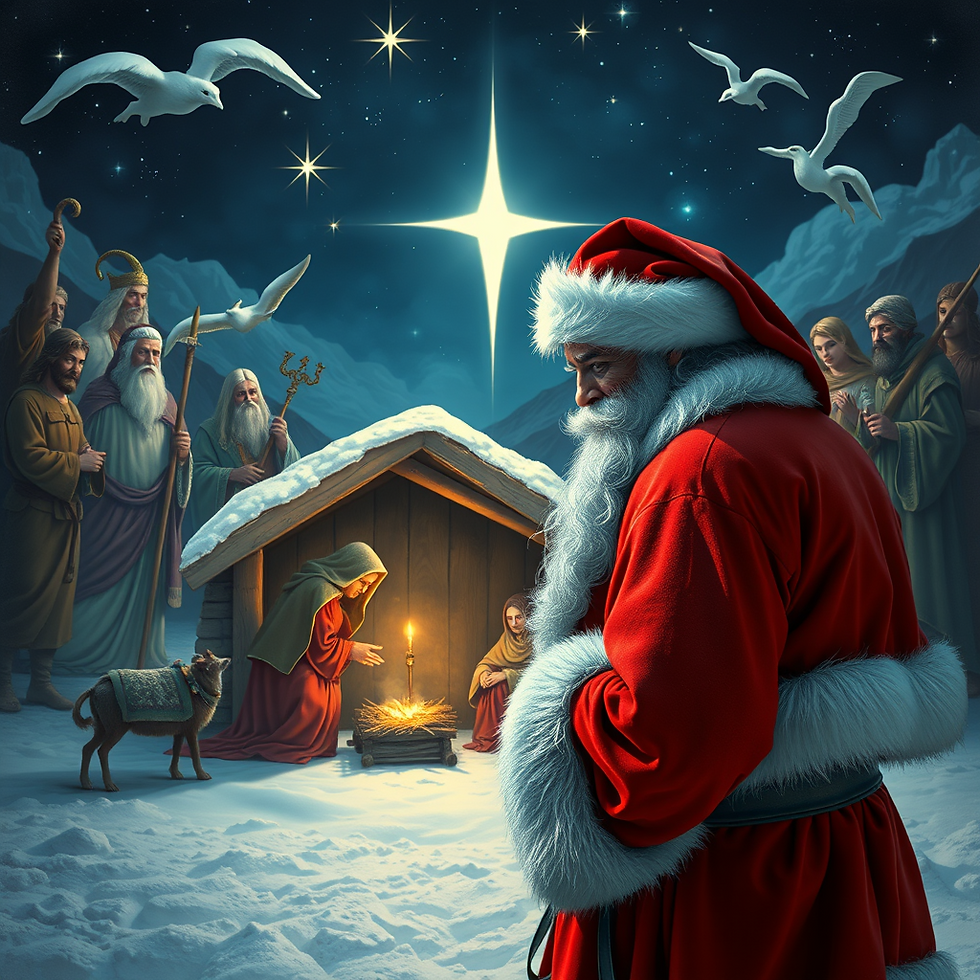
The Tangled Roots of Christmas: Syncretism, Appropriation, and the Making of a Western Festival
Christmas, as celebrated across the Western world, represents one of history's most successful exercises in cultural syncretism and religious appropriation.
The festival we recognise today—with its decorated trees, gift-giving, feasting, and associations with winter warmth and familial gatherings—bears only superficial resemblance to the biblical nativity it ostensibly commemorates.
Instead, it stands as a palimpsest of pre-Christian traditions, medieval innovations, and Victorian reinventions, each layer obscuring and transforming what came before.
The most fundamental act of appropriation lies in the date itself. The Gospels do not indicate that Jesus was born on 25th December; early Christians celebrated the Epiphany (6th January) as the more significant date. The selection of 25th December emerged in the fourth century CE, a calculated decision to supplant the Roman festival of Sol Invictus—the "Unconquered Sun"—which marked the dies natalis solis invicti.
This was no coincidence.
The winter solstice had long been celebrated across Indo-European cultures as the moment when the sun's power begins to wax again, promising the return of light and life. By claiming this date, the Church sought to redirect the deep-seated human impulse to celebrate the solstice's astronomical significance towards a new theological meaning.
Yet Sol Invictus was itself a relatively late Roman innovation, instituted by Emperor Aurelian in 274 CE. Behind it lay far older celebrations. The Romans had long observed Saturnalia, a raucous festival beginning on 17th December that featured role reversals (masters serving slaves), gambling, gift-giving, and the suspension of normal social rules.
The Lord of Misrule—a temporary king who presided over the chaos—would find his echo in later Christmas celebrations, particularly in medieval and Tudor England. The tradition of gift-giving, now central to Christmas, owes more to Saturnalia than to the Gospel account of the Magi's offerings.
The Germanic peoples contributed some of Christmas's most recognisable symbols. The decorated evergreen tree, now synonymous with the festival, derives from pre-Christian practices in which evergreens symbolised life persisting through winter's death. The Norse Yule log, burned to ward off evil spirits and ensure the sun's return, was seamlessly incorporated into the Christian celebration. Holly, ivy, and mistletoe—all significant in Celtic and Germanic pagan practice—were reinterpreted as Christian symbols, though their older associations with fertility, protection, and the vegetative cycle remained barely concealed.
The figure of Father Christmas himself represents a particularly complex syncretism.
Saint Nicholas of Myra, a fourth-century bishop known for secret gift-giving, provided the Christian foundation. Yet this figure absorbed characteristics from far older sources: the Norse god Odin, who rode through winter skies on an eight-legged horse (compare the eight reindeer); the wild man of Germanic winter folklore; and various gift-bearing figures from across European tradition.
The modern Santa Claus, commercialised and standardised in the nineteenth and twentieth centuries, bears scant resemblance to the austere Byzantine saint, having been thoroughly secularised and reshaped by commercial interests—most notably through Coca-Cola's marketing campaigns.
The practice of wassailing and carolling emerged from older traditions of singing to apple trees to ensure good harvests and the ritual procession of disguised figures demanding food and drink—practices with roots in folk magic and community cohesion rituals. The Christmas feast itself, with its emphasis on abundance amid scarcity, echoes countless winter festivals designed to reassure communities that spring would come and prosperity return.
Victorian Britain contributed perhaps the most decisive transformation of Christmas, creating much of what we now consider "traditional". Charles Dickens's A Christmas Carol (1843) essentially invented the modern sentimental conception of the festival as a time for family, charity, and redemption. Prince Albert popularised the decorated tree (a German import), whilst commercial interests seized upon the festival's potential for profit. This Victorian reinvention was itself an appropriation—taking scattered folk customs, semi-forgotten traditions, and Christian observances and forging them into a coherent, middle-class domestic celebration.
The modern Christmas also demonstrates more recent appropriations. The centrality of shopping and consumption represents capitalism's appropriation of religious and folk culture. The phrase "putting Christ back in Christmas" ironically ignores that Christ was, in many senses, a relative latecomer to these winter celebrations. Meanwhile, the secular Christmas—celebrated by non-Christians and atheists alike—represents yet another transformation, appropriating Christian appropriations of pagan festivals into a generalised winter celebration divorced from any specific religious meaning.
What troubles many observers is not syncretism per se—all living traditions borrow and adapt—but the historical amnesia and false claims to authenticity that often accompany Christmas celebrations. Claims that Christmas is "purely Christian" ignore the festival's demonstrably syncretic nature, whilst assertions that it is "really pagan" often oversimplify complex processes of cultural evolution and mutual influence. The reality is messier: Christmas represents layers of appropriation, with each generation borrowing, transforming, and reinterpreting symbols and practices to meet contemporary needs and values.
From an occult perspective, Christmas retains powerful symbolic and magical significance precisely because of its syncretic nature. The focus on light in darkness, the decorated tree as world-axis, the gift-giving as sympathetic magic to ensure abundance—these work at archetypal levels regardless of surface explanations. The festival taps into deep human responses to the solar cycle and the psychological need for hope during the darkest time of year. In this sense, the appropriation and syncretism have created something genuinely potent: a festival that speaks to multiple levels of meaning simultaneously.
Christmas as we know it is nobody's authentic tradition and everybody's. It is Roman and Germanic, Christian and pagan, commercial and spiritual, religious and secular. This very multiplicity makes it adaptable and resilient, capable of meaning different things to different people whilst maintaining enough common symbolism to serve as a shared cultural experience. The appropriations and syncretisms that created it are not bugs but features—the mechanism by which human cultures evolve, adapt, and make meaning in changing circumstances.
Whether we celebrate it as Christians commemorating a nativity, as pagans marking the solstice, or as secular participants in a cultural tradition, we are all inheritors of this tangled history, participating in a festival that belongs to no single tradition because it belongs, in fragments, to many.
Alan /|\


Comments