Spiritual Shoplifting
How the West Learned to Plunder the Sacred
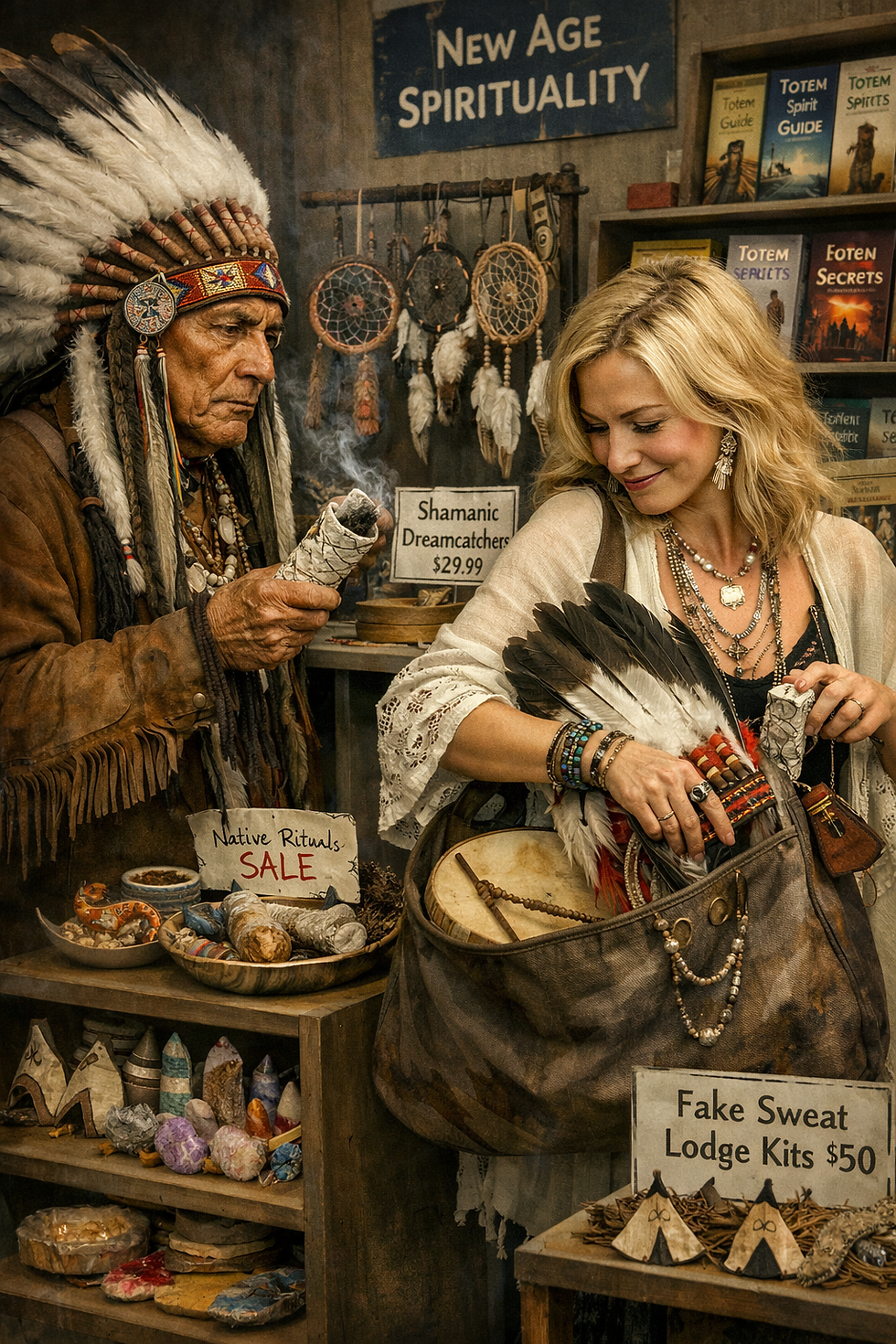
Spiritual Shoplifting:
How the West Learned to Plunder the Sacred
When the New Age movement decided that indigenous traditions were a spiritual buffet, it forgot that some dishes belong to people who might object to having them stolen, repackaged, and sold at £180 a head.
There is a peculiar kind of audacity that belongs almost exclusively to the Western spiritual seeker. It is the audacity of a person who, having grown bored with their own cultural inheritance, decides to help themselves liberally to someone else’s — and then, with breathtaking sincerity, charges admission.
The New Age movement, which reached its most florescent absurdity sometime in the 1980s and has shown no signs of wilting since, represents perhaps the most comprehensive exercise in spiritual shoplifting the world has ever seen. It has borrowed from Native American traditions, Hinduism, Buddhism, Andean cosmology, West African spirituality, and Aboriginal Australian Dreaming, usually without permission, frequently without comprehension, and almost invariably without consequence.
The resulting mishmash — what the scholar Philip Jenkins called “borrowed religions” — is a monument to the colonial imagination’s most enduring reflex: the conviction that other people’s sacred things exist primarily for our improvement.
The Anatomy of a Spiritual Raid
Cultural appropriation in the New Age context follows a remarkably consistent pattern. First, a Western practitioner encounters an indigenous or Eastern tradition, usually through a book, a retreat, or a romantically distorted documentary. They are seized by a profound sense of connection. A feeling, curiously, that arrives fully formed without the decades of initiation, linguistic study, or community membership that the tradition actually requires. Within weeks, sometimes days, they have begun to teach. Within months, they may well be charging for it.
The process tends to involve three reliable stages.
The first is Decontextualisation: the sacred object, practice, or concept is lifted clean out of its living cultural context and reframed as a universal spiritual technology.
The second is Commodification: it is priced, packaged, and marketed — typically using fonts that gesture vaguely towards antiquity.
The third is Personalisation: the appropriator has a visionary experience or a healing crisis that conveniently positions them as uniquely gifted custodians of the tradition they have just invented their own version of.
“The sacred sweat lodge, refined over centuries by Lakota peoples as a site of communal prayer and purification, was reimagined by the New Age as a forty-eight-hour self-actualisation intensive at £300 per person. The Lakota did not receive a finder’s fee.”
The American Indian Supermarket
No tradition has been more comprehensively raided than that of North America’s indigenous peoples. The irony, and it is the darkest possible variety of irony, is that this looting occurs against the backdrop of centuries of colonisation that attempted, with considerable violence, to suppress the very traditions now being enthusiastically consumed.
Having outlawed indigenous ceremonies, confiscated sacred objects, and forced children into residential schools designed to eradicate native culture, Western civilisation subsequently decided that the same culture was, actually, rather interesting, and began selling it back to itself at a premium.
The vision quest is perhaps the most instructive example. In its original Lakota context, the hanblečeya is a profoundly demanding ritual of prayer, fasting, and isolation, undertaken within a specific relational framework; with a particular community, particular protocols, particular responsibilities. It is not a product. It does not come with a certificate of completion. Yet by the 1990s, the vision quest had been comprehensively domesticated by New Age entrepreneurs, rebranded as a therapeutic wilderness experience, and marketed to stressed urban professionals seeking, in the words of one brochure that probably still exists, “an authentic encounter with your deeper self.”
The dreamcatcher, meanwhile, underwent one of the most spectacular debasements in the history of sacred objects. Originating among the Ojibwe people as a protective charm for sleeping children, filtered through romanticised Pan-Indian imagery, it arrived in the Western imagination as a generic “Native American” decorative item available in petrol stations throughout the developed world. At this point it had roughly as much connection to Ojibwe spiritual practice as a leprechaun tea towel has to Celtic theology.
Footnote: A Taxonomy of Offences
The sweat lodge tragedy of 2009, in Sedona, Arizona, deserves particular attention. Self-help guru James Arthur Ray charged attendees $10,000 each for a spiritual warrior retreat climaxing in a sweat lodge ceremony he had constructed without reference to any tradition whatsoever. Three people died of hyperthermia. Ray was convicted of negligent homicide. Lakota elders, who had been publicly condemning the commercialisation of sweat lodges for years, were afforded the bleak satisfaction of having been entirely correct.
The spiritual appropriation industry has consequences that extend beyond the merely aesthetic.
Hinduism: The Greatest Self-Service Buffet in Spiritual History
If the indigenous American traditions represent the most morally freighted instance of New Age appropriation, Hinduism represents the most extensive. The sheer volume of Hindu concepts, practices, and cosmological frameworks that have been extracted, stripped of context, and reissued under different branding is staggering.
Yoga, chakras, karma, mantra, mudra, prana, the third eye, Kundalini, Shakti, non-duality. All have been processed through the New Age machine and emerged as the philosophical infrastructure of the Western wellness industry.
Yoga deserves special consideration, not because it is the most egregious case but because it has become the most normalised. Modern Western yoga bears approximately the relationship to its classical origins that karaoke bears to opera.
The classical traditions — whether Patanjali’s eight-limbed system, the various Tantric lineages, or the devotional practices of Bhakti — are coherent philosophical and spiritual systems embedded in centuries of lived tradition, teacher-student transmission, and theological sophistication.
What appears on the schedule of the average British leisure centre is a stretching class with Sanskrit branding.
None of this is to say that yoga, in its adapted Western forms, has no value. It manifestly has considerable value for many practitioners. The objection is not to cross-cultural borrowing per se — cultures have always influenced one another — but to the specific combination of commercial extraction, wholesale decontextualisation, and ignorance that characterises so much New Age engagement with Hindu material.
When a wellness brand trademarks a Sanskrit mantra and sells it as a “mindfulness tool,” it is not engaging in cultural dialogue. It is engaged in what might more accurately be called intellectual asset-stripping.
“The chakra system, a sophisticated metaphysical framework embedded in Tantric cosmology, was processed by the New Age into a colour-coded diagram that could be printed on a linen tote bag and sold at a wellbeing fair in Totnes.”
The Shamanism Problem
“Shamanism” deserves a section of its own, partly because it is an excellent example, and partly because the very word is an illustration of the problem.
Derived from the Tungusic šaman, it was appropriated by Western anthropology as a catch-all term for an extraordinarily diverse range of ritual specialist roles across vastly different cultures. The New Age then took this already-blurred category and rendered it into something approaching a universal spiritual brand.
The contemporary “shamanic practitioner” is a figure of some sociological fascination. They may have studied with a Peruvian ayahuascero, attended a weekend workshop with a Core Shamanism trainer, read three books by Michael Harner, and emerged confident in their ability to offer “shamanic healing sessions” to clients in a yurt in the Cotswolds.
The ayahuascero, who has spent years under apprenticeship learning plant medicine traditions specific to their particular community and ecosystem, might have a view about this. That view is not typically solicited.
The ayahuasca tourism industry, which grew substantially over the 2010s, is the commercial apotheosis of this dynamic. Peruvian and Amazonian ceremonial traditions involving the brew were marketed to Western travellers as transformative experiences — which they often genuinely are — while the communities whose traditions were being commodified frequently saw little economic benefit, watched sacred practices commercialised beyond recognition, and confronted the destabilising social effects of large numbers of unprepared foreigners arriving in states of acute psychological crisis.
The Curious Innocence of the New Age Seeker
It would be satisfying if one could simply characterise the appropriators as cynics — hucksters knowingly exploiting both indigenous traditions and credulous Western consumers for profit. Some certainly are. But the more pervasive and perhaps more troubling figure is the true believer: the person who genuinely loves the tradition they have misappropriated, who sincerely believes they are honouring it, and who is baffled. sometimes affronted. when indigenous practitioners decline to be honoured in this fashion.
This sincerity is not a defence. It is, arguably, the most perfect expression of the colonial mentality: the assumption that one’s good intentions exempt one from accountability to the people whose heritage one is consuming. When a Lakota elder objects to a non-Lakota person conducting sweat lodge ceremonies, and is told that they are being divisive, that “spirituality belongs to everyone,” or that the objector has “missed the point,” the ghost of a very old and very ugly dynamic is present in the room.
The phrase “spirituality belongs to everyone” is worth dwelling on. It sounds generous. It is, in practice, a mechanism for absolving oneself of the obligation to understand, respect, or defer to the people whose specific spiritual heritage one is enjoying. It is the spiritual equivalent of saying “art belongs to everyone” while shoplifting from a gallery.
A Note on Genuine Exchange
It bears repeating that cross-cultural spiritual engagement is neither inherently wrong nor historically unusual. The question is always one of relationship: whether exchange is mutual, whether it occurs with the informed consent of source communities, whether practitioners acknowledge their sources and their limitations, whether they support the living traditions from which they draw, and whether they are willing to be corrected.
There are Western practitioners who engage with traditions not their own with genuine humility, sustained study, and real relationships with source communities. They tend to be distinguished by how much they speak about what they don’t know. The Dunning-Kruger curve of spiritual appropriation has a recognisable shape: the most confident claims of mastery come earliest, and the deepest humility — if it comes at all — comes latest.
What Is Actually Lost
The harms of New Age cultural appropriation are sometimes framed as matters of feeling — indigenous communities are offended, and their feelings deserve consideration. This framing, while not wrong, understates the case considerably. What is at stake is not primarily sentiment but material, cultural, and spiritual reality.
When sacred practices are commercialised, they are frequently distorted beyond the point where their original meaning can be transmitted. Communities who have maintained traditions through extraordinary adversity, including active suppression, find those traditions flooded with practitioners who have no lineage, no accountability, and no obligation to the community. The result can be a dilution that makes the authentic practice harder to see, harder to learn, and harder to transmit. The appropriation industry creates noise that obscures signal.
There is also an economic dimension. The global wellness industry, of which New Age spirituality is a significant component, is worth several trillion poundss. The communities whose knowledge, practices, and cosmologies underpin much of this industry have, in general, received an amount approximating to nothing. The extraction of intellectual and spiritual property from marginalised communities and its conversion into capital that flows primarily to members of dominant cultures is a pattern with a long history. The fact that it currently arrives wearing linen and carrying a singing bowl does not substantially alter its character.
The Telescope and the Crystal Ball
The genuine esoteric traditions of the world — in their extraordinary diversity, their intellectual sophistication, their capacity for sustained inquiry into the nature of consciousness and reality — deserve better than this. They deserve engagement that is rigorous, humble, and honest about its limitations. They deserve practitioners who know the difference between adopting a tradition and consuming it.
The Rational Mystic position is not that mystery has no place in a sceptical world, nor that traditions other than one’s own are off-limits. It is rather that genuine engagement with the sacred — wherever it is encountered — requires the same qualities that genuine engagement with anything requires: intellectual honesty, epistemic humility, and the willingness to be told you are wrong by people who know more than you do.
Cultures are not buffets. Sacred things are not products. Wisdom traditions maintained through centuries of hardship and transmission are not content for your wellbeing brand. And the fact that a tradition makes you feel connected, whole, and profoundly alive does not mean that it belongs to you.
There is, somewhere in all of this, a genuinely interesting irony. The New Age’s hunger for the sacred — its desperate, sometimes moving search for meaning beyond the material — is itself a diagnosis of something real: the spiritual impoverishment of a culture that dismantled its own mythologies and then discovered, too late, that they had been load-bearing. That is worth taking seriously. But the response to finding yourself without a spiritual home is not to burgle someone else’s.
Alan /|\


Comments